
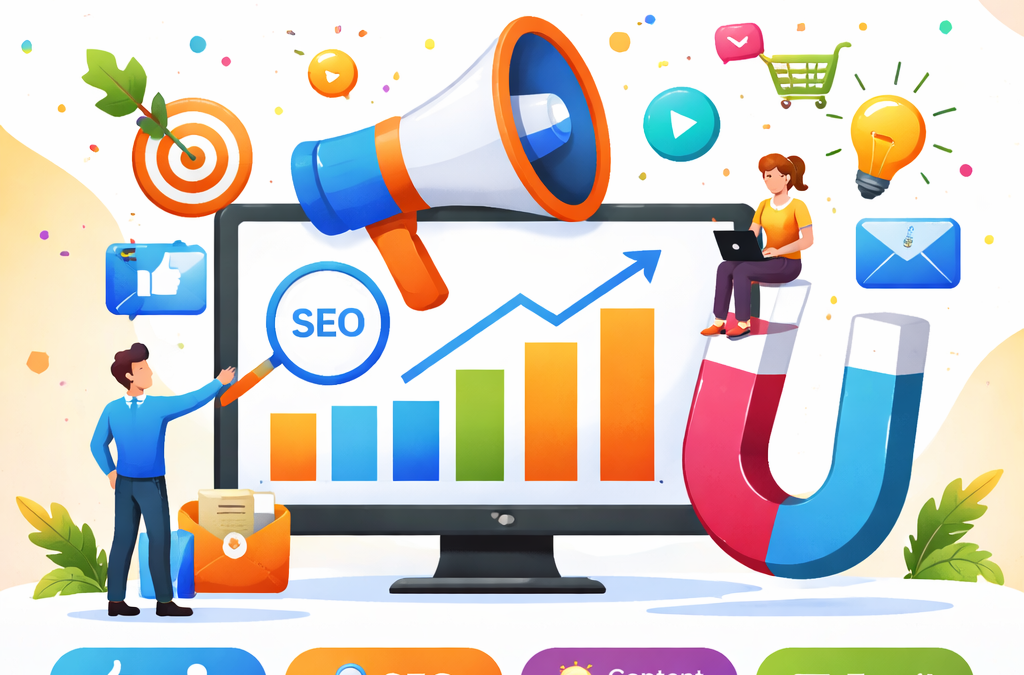
Digital marketing is the practice of promoting products, services, or brands through internet-based channels such as search engines, social media, email, and websites. It is important because it helps businesses reach more people, spend less money than traditional advertising, and measure every result in real time. Whether you run a small local shop or a global company, having the best digital marketing knowledge gives you the tools to grow in a world that is always online.
Contents
- 1 Table of Contents
- 2 What Is Digital Marketing?
- 3 How Digital Marketing Is Different from Traditional Marketing
- 4 The Main Types of Digital Marketing
- 5 What is Digital Marketing Is Important for Every Business
- 6 Here is why digital marketing has become essential.
- 7 How Search Engines Work in Digital Marketing
- 8 Social Media Marketing: Reaching People Where They Spend Time
- 9 Content Marketing: Why Words, Videos, and Images Drive Growth
- 10 Email Marketing: The Old Tool That Still Wins
- 11 Pay-Per-Click Advertising: Getting Fast Results
- 12 Affiliate Marketing and Influencer Marketing
- 13 Data and Analytics: The Backbone of Smart Marketing
- 14 Digital Marketing for Small Businesses
- 15 The Future of Digital Marketing
- 16 How to Build the Best Digital Marketing Knowledge
- 17 FAQs: What People Also Ask About Digital Marketing
Table of Contents
- What Is Digital Marketing?
- How Digital Marketing Is Different from Traditional Marketing
- The Main Types of Digital Marketing
- Why Digital Marketing Is Important for Every Business
- How Search Engines Work in Digital Marketing
- Social Media Marketing: Reaching People Where They Spend Time
- Content Marketing: Why Words, Videos, and Images Drive Growth
- Email Marketing: The Old Tool That Still Wins
- Pay-Per-Click Advertising: Getting Fast Results
- Affiliate Marketing and Influencer Marketing
- Data and Analytics: The Backbone of Smart Marketing
- Digital Marketing for Small Businesses
- The Future of Digital Marketing
- How to Build the Best Digital Marketing Knowledge
- FAQs
What Is Digital Marketing?
is marketing that happens on the internet.
Any time a business uses a website, a search engine, a social media platform, an app, or email to reach customers, it is doing digital marketing. The goal is always the same: connect with the right people, at the right time, with the right message.
Think of it this way. Thirty years ago, if you opened a bakery, you might put an ad in the local newspaper, hang posters around town, or pay for a spot on the radio. That is traditional marketing. It reaches people in the physical world.
Today, people search Google before they visit a store. They check Instagram before they trust a brand. They read reviews on their phones before they buy anything. So businesses need to meet people where they already are — and most people are online.
Digital marketing does exactly that.
It covers a wide range of activities: writing blog posts that show up in search results, running ads on Facebook, sending promotional emails, posting videos on YouTube, partnering with influencers, and much more. All of these fall under the broad umbrella of digital marketing.
The best digital marketing knowledge starts with understanding this: digital marketing is not one single thing. It is a set of connected strategies that work together to build awareness, generate leads, and drive sales.
How Digital Marketing Is Different from Traditional Marketing
Traditional marketing and digital marketing share the same goal. Both want to put a product or service in front of potential buyers. But the way they do it is very different.
Traditional marketing uses:
- Newspapers and magazines
- TV commercials
- Radio spots
- Billboards and flyers
- Direct mail (physical letters sent to homes)
These methods can reach a lot of people. But they are expensive. And you can never be completely sure how many people actually saw your ad, paid attention to it, or acted on it.
Digital marketing uses:
- Search engines like Google
- Social media platforms like Instagram, Facebook, and LinkedIn
- Email inboxes
- YouTube and streaming platforms
- Websites and apps
With digital marketing, you can track almost everything. You can see how many people clicked your ad, how long they stayed on your website, which email subject line got more opens, and which products people added to their cart but did not buy. This level of detail gives you real power to improve and grow.
Another major difference is cost. A 30-second TV commercial during a popular show can cost thousands of dollars and is out of your control once it airs. A Facebook ad campaign can start with as little as five dollars a day. You can pause it, change the message, or target a completely different audience in minutes.
Digital marketing also allows personalization at scale. A billboard says the same thing to everyone who drives past it. A digital ad can show one message to a 25-year-old woman in Mumbai who loves yoga and a completely different message to a 50-year-old man in Delhi who runs a restaurant. The same campaign, but tailored to each person.
That flexibility, speed, and measurability are what make digital marketing so powerful.
5 Digital Marketing Myths Busted — Smarter Ways to Boost Your SuccessBlog
The Main Types of Digital Marketing
Digital marketing is made up of several different disciplines. Each one works in a different way and serves a different purpose. Knowing all of them is a big part of building the best digital marketing knowledge.
Search Engine Optimization (SEO)
SEO is the process of making your website show up higher in search engine results without paying for ads. When someone types a question into Google and your website appears at the top, that is SEO doing its job.
SEO involves choosing the right keywords, writing helpful content, making your website fast and easy to use, and getting other websites to link back to yours. It is a long-term strategy. You will not see results overnight. But over time, good SEO brings a steady stream of free traffic to your website.
Pay-Per-Click Advertising (PPC)
PPC is a type of paid advertising where you only pay when someone actually clicks on your ad. Google Ads is the most popular PPC platform. When you search for something on Google, the results at the very top (marked “Sponsored”) are PPC ads.
PPC gives you immediate visibility. Unlike SEO, you do not have to wait months to see results. You can launch a campaign today and have traffic on your website by tonight. The tradeoff is that you pay for every click, and costs can add up quickly if you do not manage your campaigns carefully.
Social Media Marketing
Social media marketing involves using platforms like Instagram, Facebook, TikTok, X (formerly Twitter), LinkedIn, and Pinterest to build brand awareness and engage with your audience.
You can do social media marketing for free by posting organic content — photos, videos, stories, reels, and text updates. You can also pay to run ads that appear in people’s feeds. Social media is especially powerful for building a community around your brand and talking directly to your customers.
Content Marketing
Content marketing is about creating and sharing valuable information that helps your audience. Blog posts, videos, podcasts, infographics, eBooks, webinars — all of these are forms of content marketing.
The idea is simple. If you consistently give people useful information, they start to trust you. When they are ready to buy, they come to you first. Content marketing works hand-in-hand with SEO because good content is what search engines reward.
Email Marketing
Email marketing is sending messages directly to a list of people who have agreed to hear from you. It is one of the oldest forms of digital marketing and still one of the most effective.
Studies consistently show that email delivers one of the highest returns on investment (ROI) of any digital marketing channel. For every dollar spent on email marketing, businesses earn an average of $36 to $42 back.
Affiliate Marketing
Affiliate marketing involves partnering with other people or websites who promote your products in exchange for a commission on each sale. You only pay when a sale happens. This makes it a very low-risk strategy for businesses.
Influencer Marketing
Influencer marketing is similar to affiliate marketing but focuses on social media creators. Brands pay influencers — people with large or loyal followings on Instagram, YouTube, or TikTok — to feature their products. This works because people trust recommendations from people they already follow and admire.
Video Marketing
Video is now one of the most consumed types of content online. YouTube is the second largest search engine in the world after Google. Short-form videos on TikTok and Instagram Reels are watched by billions of people every day.
Businesses that invest in video marketing can explain their products more clearly, show results visually, and build a stronger emotional connection with their audience. What is Digital Marketing
https://www.investopedia.com/terms/d/digital-marketing.asp
What is Digital Marketing Is Important for Every Business
This is the question most business owners ask. Is digital marketing actually necessary? Can a business survive without it?
The honest answer is: less and less.
1. Your Customers Are Online
Here is why digital marketing has become essential.
There are more than 5.4 billion internet users in the world as of 2025. In many countries, almost every adult is online. People search for restaurants, doctors, plumbers, clothes, and information on their phones and computers every single day.
If your business does not have an online presence, you are invisible to a massive portion of your potential customers.
2. It Is More Affordable Than Traditional Marketing
A small business cannot afford a TV commercial. But it can afford a Facebook ad, a blog, and a free Google Business profile. Digital marketing levels the playing field. A well-run digital strategy from a small brand can outperform a large brand with a big traditional advertising budget.
3. You Can Measure Everything
In traditional marketing, you spend money and hope it works. In digital marketing, you know. You can see exactly how many people saw your post, how many clicked your ad, how many bought your product, and how much each sale cost you. This data lets you cut what is not working and invest more in what is.
4. You Can Reach the Right People
Digital marketing allows you to target your audience with incredible precision. You can target people based on their age, location, income, interests, browsing history, and even what they searched for recently. This means less wasted spend and more relevant advertising.
5. It Builds Long-Term Trust
When your business consistently shows up in search results, posts helpful content, responds to reviews, and maintains an active social media presence, people begin to trust you. Trust is what turns a stranger into a customer and a customer into a loyal fan.
6. You Can Compete Globally
Digital marketing removes geographical limits. A handcraft business in Jaipur can sell to a customer in London. A software company in Bangalore can get clients in New York. A YouTube channel made in Lagos can have viewers in Tokyo. Geography is no longer a barrier.
7. It Is Always On
A shop closes at night. A website never does. Your digital marketing — your blog posts, your social media profiles, your search engine rankings, your email sequences — works for you 24 hours a day, seven days a week, even while you sleep.
How Search Engines Work in Digital Marketing
Understanding search engines is one of the most valuable parts of building the best digital marketing knowledge. Google processes more than 8.5 billion searches every single day. If your business can appear in those results, you have access to an enormous audience.
But how does Google decide which websites to show? What is Digital Marketing
Google uses a complex algorithm — a set of rules — to rank websites. This algorithm considers hundreds of factors. But the core ones come down to three things:
Relevance: Does your page answer what the person searched for? Google reads your content and tries to understand what it is about. That is why using the right keywords and covering topics thoroughly matters.
Authority: Does Google trust your website? Trust is largely measured through backlinks — other websites that link to yours. When respected sites link to you, Google sees it as a vote of confidence.
Experience: Is your website fast, mobile-friendly, and easy to use? Google pays close attention to how users interact with your site. If visitors arrive and leave immediately, that tells Google your page did not give them what they wanted.
Optimizing for these three factors is the heart of SEO. And SEO is one of the most valuable long-term investments in digital marketing.
Voice search is also growing fast. People now ask their phones and smart speakers questions in natural, conversational language: “What is the best coffee shop near me?” or “How do I fix a leaking pipe?” Businesses that optimize for these longer, question-based searches gain a significant advantage.
Social Media Marketing: Reaching People Where They Spend Time
The average person spends nearly 2.5 hours on social media every day. That is a lot of time — and a lot of opportunity for businesses.
Social media marketing is not just about posting pretty pictures. It is about building a presence, telling a story, engaging in conversations, and creating content that people want to share.
Choosing the Right Platform
Different social platforms attract different audiences. Choosing the right one is key.
- Instagram and TikTok are strong for visual brands — fashion, food, fitness, travel, beauty.
- LinkedIn is the place for B2B (business-to-business) marketing, professional services, and recruitment.
- Facebook has a broad, older demographic and powerful ad targeting tools.
- YouTube is ideal for in-depth tutorials, product reviews, and educational content.
- X (Twitter) works well for real-time conversations, news, and brand personality.
- Pinterest drives strong traffic for home décor, recipes, DIY, and fashion.
Organic vs. Paid Social Media
Organic social media is when you post content without paying. You build followers over time through consistent posting and engagement.
Paid social media is when you run ads. You pay to put your content in front of a specific audience — even people who do not follow you. Paid social is precise, fast, and scalable.
The best strategy usually combines both. Organic builds community. Paid amplifies your best content and drives targeted traffic.
The Role of Engagement
On social media, engagement (likes, comments, shares, saves) is the currency. Platforms reward content that sparks interaction by showing it to more people. Businesses that ask questions, respond to comments, share user-generated content, and participate in conversations tend to grow much faster than those that just broadcast and disappear.
Content Marketing: Why Words, Videos, and Images Drive Growth
“Content is king” is one of the most repeated phrases in digital marketing. It is also one of the most true.
Content marketing is the process of creating content that helps, entertains, or educates your target audience — without directly pushing a sale. Over time, this builds trust, authority, and a loyal following.
Why Content Marketing Works
People do not want to be sold to. They want information. They want solutions to their problems. They want to feel understood.
When your brand consistently provides that — through blog posts, YouTube videos, podcasts, infographics, or social media posts — you build a relationship with your audience before they ever buy from you.
This is called the know, like, trust model. People buy from brands they know, like, and trust. Content marketing is what gets you there.
Types of Content That Perform Well
Blog posts and articles are the foundation of most content marketing strategies. Well-written articles that answer common questions can rank in Google for years, bringing in free traffic continuously.
Videos are the fastest-growing content type. A product demo, a how-to tutorial, a customer success story — all of these perform well on YouTube and social platforms.
Infographics make complex information easy to understand visually. They are highly shareable and often picked up by other websites, which helps build backlinks.
Podcasts are growing rapidly. They build a deep, intimate connection with listeners who tune in regularly during commutes, workouts, or daily routines.
Case studies show real results from real customers. They are powerful because they prove that your product or service works.
Content and SEO Are a Team
Great content without SEO does not get found. Good SEO without quality content does not satisfy readers. The two must work together.
Write content that is genuinely helpful and thorough. Use the words your audience is searching for. Structure your pages clearly. And make sure your website is fast and easy to navigate. That combination is what earns top rankings.
Email Marketing: The Old Tool That Still Wins
digital marketing Email has been around since the early days of the internet. Every few years, someone predicts its death. And every few years, it proves them wrong.
Email marketing remains one of the most powerful channels in all of digital marketing. Here is why.
You Own Your Email List
On social media, you are renting space on someone else’s platform. If Instagram changes its algorithm or a platform shuts down, your follower count can drop to zero overnight. But your email list? You own it. No platform can take it from you.
Email Is Personal
When an email lands in someone’s inbox, it feels personal. It is not competing with dozens of other posts in a social media feed. It is a direct message to one person.
Good email marketing takes advantage of this. Personalized emails that use the reader’s name, reference their past behavior, and offer relevant content or offers feel like a genuine communication — not a mass blast.
Automation Makes It Scalable
Modern email marketing platforms let you set up automated sequences that run on their own. A new subscriber gets a welcome email. A shopper who abandons their cart gets a reminder. A customer who has not bought in six months gets a re-engagement offer.
These automations work around the clock without any manual effort. They deliver the right message to the right person at exactly the right moment.
Building a Healthy Email List
The quality of your email list matters more than its size. A list of 500 people who are genuinely interested in what you offer will outperform a list of 10,000 people who barely remember signing up.
Grow your list by offering something valuable: a free guide, a discount code, a mini-course, a webinar, or exclusive access to something your audience wants. Then nurture that list consistently with content that is worth reading.
Pay-Per-Click Advertising: Getting Fast Results
SEO and content marketing take time. If you need traffic and leads quickly, PPC advertising is your best option.
How PPC Works
With PPC, you bid on keywords. When someone searches for that keyword on Google, your ad has a chance to appear at the top of the results page. You only pay when someone actually clicks the ad.
The cost per click varies by keyword. Highly competitive keywords in industries like insurance, law, or finance can cost $10 to $50 per click. Less competitive keywords in niche markets can cost as little as a few rupees or cents.
What Makes a PPC Campaign Work
Running successful PPC ads requires more than just picking keywords and writing ad copy. You need:
A clear goal. Are you trying to get phone calls, form submissions, product sales, or website visits? Your goal determines everything else.
Strong landing pages. When someone clicks your ad, they go to a landing page. If that page is confusing, slow, or irrelevant, they will leave immediately. Your landing page must match what the ad promised and make it very easy to take the next step.
Ongoing optimization. PPC is not a set-it-and-forget-it channel. You must monitor your campaigns, test different ad versions, pause what is not working, and put more budget into what is.
Negative keywords. These are words you tell Google NOT to show your ad for. If you sell premium watches, you do not want your ad showing up when someone searches “cheap watches.” Adding negative keywords saves money and improves results.
Google Ads vs. Social Ads
Google Ads (also called search ads) show your ad when someone actively searches for a keyword. They are high-intent — the person is already looking for what you offer.
Social ads (on Facebook, Instagram, TikTok) show your ad to people who match your target audience, even if they are not actively searching for anything. They are great for building awareness and reaching new audiences who have never heard of your brand.
Both have value. The right choice depends on your goals, industry, and budget.
Affiliate Marketing and Influencer Marketing
These two channels are often misunderstood but can be incredibly powerful when used correctly.
Affiliate Marketing
In affiliate marketing, you partner with other people or websites — called affiliates — who promote your product in exchange for a commission. An affiliate might write a review of your software, include a link in a YouTube video, or promote your product in their email newsletter.
The beauty of affiliate marketing is the risk structure. You only pay when a sale actually happens. There is no upfront cost. Many large e-commerce businesses generate a significant portion of their revenue through affiliate partnerships.
For people looking to earn money online, becoming an affiliate for other brands is also a popular path. You promote products you believe in, and you earn a percentage of every sale made through your link.
Influencer Marketing
Influencer marketing has exploded in the last decade. Brands partner with creators on Instagram, YouTube, TikTok, and other platforms to reach their audiences.
The key is relevance, not reach. A fitness brand partnering with a fitness creator who has 50,000 engaged followers will often get better results than partnering with a celebrity who has 5 million followers but no connection to health and wellness.
Micro-influencers — creators with audiences between 10,000 and 100,000 — often deliver the highest engagement rates and the most trust. Their audiences feel like they know them personally, which makes product recommendations land with more credibility.
When done well, influencer marketing feels less like advertising and more like a recommendation from a friend. That is its superpower.
Data and Analytics: The Backbone of Smart Marketing
Guessing is expensive. Data is cheap. The best digital marketers do not rely on instinct alone. They make decisions based on real information.
What You Can Measure in Digital Marketing
Almost everything in digital marketing can be tracked:
- How many people visited your website and where they came from
- Which pages they visited and how long they stayed
- Where they dropped off (and why)
- Which ads generated the most clicks and at what cost
- Which email subject lines got more opens
- Which social media posts got the most engagement
- Which products people looked at without buying
This data tells you what is working and what is not. It removes the guesswork.
Key Metrics Every Marketer Should Know
Traffic: How many people visit your website. More traffic is not always better — relevant traffic is what counts.
Conversion Rate: The percentage of visitors who take a desired action (buying a product, filling out a form, signing up for an email list). A 2% conversion rate means two out of every 100 visitors convert.
Cost Per Acquisition (CPA): How much you spend on average to get one customer. Lower is better, but the real question is whether your CPA is lower than the value of that customer.
Customer Lifetime Value (CLV): How much revenue a customer generates over their entire relationship with your business. A customer who spends $50 once is less valuable than a customer who spends $20 a month for three years.
Return on Investment (ROI): The profit you earn relative to what you spent on marketing. If you spend $1,000 on a campaign and earn $4,000 in sales, your ROI is 300%.
Bounce Rate: The percentage of visitors who land on your page and leave without doing anything. A high bounce rate often signals a mismatch between your ad and your landing page, or a poor user experience.
Tools for Digital Marketing Analytics
Google Analytics is the most widely used free analytics tool. It shows you where your website traffic comes from, what users do on your site, and how many conversions you get.
Google Search Console shows you how your site performs in Google Search — which keywords bring visitors, how often you appear in results, and what technical issues might be holding you back.
Social media platforms all have built-in analytics that show post reach, engagement, follower growth, and ad performance.
Email platforms like Mailchimp, Klaviyo, and ConvertKit show open rates, click rates, and conversions for every email you send.
Learning to read and act on this data is what separates average marketers from exceptional ones.
Digital Marketing for Small Businesses
A common misconception is that digital marketing is only for big companies with large budgets. This is simply not true.
In fact, digital marketing often benefits small businesses more than large ones. Here is why.
A big brand already has name recognition. People already know them. A small business needs to earn that awareness — and digital marketing gives it the tools to do so without a massive budget.
Where Small Businesses Should Start
Google Business Profile (formerly Google My Business) is free. It puts your business on Google Maps, shows your hours, phone number, and address, and lets customers leave reviews. For any local business, this is the single most important first step.
A simple, fast website is non-negotiable. People expect it. It builds credibility. And it gives you a place to send all your digital marketing traffic.
SEO basics should follow. Claim your niche. Write a few thorough, helpful articles on topics your customers search for. Use clear, keyword-rich page titles and descriptions.
One or two social media platforms — not all of them. Focus on the platforms where your customers actually spend time. Post consistently, engage authentically, and build community slowly.
Email marketing from day one. Even if you only have 50 subscribers, start building your list. It will become one of your most valuable assets.
The Power of Local SEO
For businesses that serve a local area — restaurants, dental offices, law firms, real estate agents, plumbers, salons — local SEO is essential.
Local SEO helps you appear when people search for businesses “near me” or in your city. It involves optimizing your Google Business Profile, getting consistent listings in online directories (NAP — Name, Address, Phone), and earning reviews from real customers.
Positive reviews on Google are one of the most powerful forms of social proof a local business can have. Encourage satisfied customers to leave reviews. Respond to every review — both positive and negative — professionally and thoughtfully.
The Future of Digital Marketing
Digital marketing is always changing. New platforms emerge. Algorithms shift. Consumer behavior evolves. Staying current is part of having the best digital marketing knowledge.
Here are the most important trends shaping the future of the field.
Artificial Intelligence in Marketing
AI is already transforming digital marketing. Tools powered by AI can now:
- Write first drafts of ad copy and blog posts
- Generate images for social media posts
- Analyze data and identify trends faster than any human
- Personalize website content for individual users in real time
- Predict which customers are most likely to buy
Marketers who learn to use AI tools effectively will be far more productive than those who do not. But AI is a tool, not a replacement for strategy, creativity, and human judgment.
The Rise of AI Search Engines
Google’s Search Generative Experience (SGE) and AI-powered answer engines like ChatGPT, Perplexity, and Gemini are changing how people find information. Instead of clicking ten links, users increasingly get a single AI-generated answer.
This means content must be structured to be featured in AI answers. Clear, direct writing that answers specific questions — like this article — is the kind of content that AI search tools pull from and recommend.
Short-Form Video Dominance
TikTok, Instagram Reels, and YouTube Shorts have changed how people consume content. Attention spans are shorter than ever. Businesses that can tell a compelling story in 30 to 60 seconds have a massive advantage.
Short-form video is now one of the fastest ways to grow an audience organically. Brands that get comfortable on camera — showing products, sharing tips, going behind the scenes — are seeing strong results.
Privacy-First Marketing
Third-party cookies are being phased out across the internet. This means the old model of tracking users across websites for ad targeting is ending. Marketers must adapt.
First-party data — information you collect directly from your own customers, like email addresses and purchase history — is becoming the most valuable asset in digital marketing. Building genuine relationships and earning direct contact with your audience is more important than ever.
Personalization at Scale
Customers expect personalized experiences. They do not want to receive an email about baby products if they bought running shoes. They do not want to see ads for things they already purchased.
The future of digital marketing is hyper-personalization — delivering the right message, to the right person, on the right channel, at the right moment. AI and smart data management make this possible even for small businesses.
How to Build the Best Digital Marketing Knowledge
If you want to develop real expertise in digital marketing, here is a clear path forward.
Start with Fundamentals
Before you run ads or build campaigns, understand the basics. Learn how search engines work. Understand the buyer’s journey. Get comfortable with marketing funnels — how a stranger becomes aware of your brand, considers what you offer, and finally decides to buy.
Free resources like Google’s Digital Garage, HubSpot Academy, and Meta Blueprint offer structured courses that cover fundamentals thoroughly.
Learn One Channel at a Time
Do not try to master everything at once. Pick one channel — SEO, email, or social media — and go deep. Read everything you can. Practice. Experiment. Measure results. Then add another channel.
Spreading yourself thin across every platform produces mediocre results everywhere. Going deep on one channel produces real expertise and real results.
Practice with Real Projects
Reading about digital marketing is useful. Doing it is essential. Create a website. Write a blog. Run a small ad campaign with a modest budget. Build an email list. Analyze the results. Make mistakes. Learn from them.
Theory only takes you so far. The best digital marketing knowledge is built through hands-on experience.
Follow Industry Sources
The digital marketing landscape changes fast. Stay current by following trusted sources:
- Search Engine Journal for SEO news and updates
- Neil Patel’s blog for practical marketing tutorials
- Moz Blog for in-depth SEO resources
- Marketing Land for industry news
- HubSpot Blog for content and inbound marketing
- Social Media Examiner for platform-specific tips
Get Certified
Certifications will not make you an expert on their own, but they show commitment and give you a structured foundation. Google’s certifications (Analytics, Ads, Digital Marketing), HubSpot certifications, and Meta Blueprint certifications are all widely recognized and free.
Specialize
As you grow, consider specializing. The digital marketing field is broad. Specialists — those who go very deep in one area — tend to command higher salaries and more respect than generalists. Become the person who knows more about technical SEO, or email automation, or YouTube advertising than almost anyone else. That focus pays off.
FAQs: What People Also Ask About Digital Marketing
Q: What is digital marketing in simple words?
Digital marketing is the practice of promoting a business or product through online channels like search engines, social media, email, and websites. It helps businesses reach more customers at a lower cost than traditional advertising.
Q: Why is digital marketing important for small businesses?
Digital marketing helps small businesses compete with larger ones by giving them access to the same online tools and platforms. It is affordable, measurable, and allows even a local business to reach customers in its area or around the world.
Q: What are the main types of digital marketing?
The main types are: Search Engine Optimization (SEO), Pay-Per-Click advertising (PPC), social media marketing, content marketing, email marketing, affiliate marketing, influencer marketing, and video marketing.
Q: Is digital marketing hard to learn?
Digital marketing has a learning curve, but it is not impossibly difficult. It takes time, practice, and a willingness to keep up with changes in the industry. Free resources and courses are widely available for beginners.
Q: How much does digital marketing cost?
Costs vary widely. SEO and content marketing require time more than money, especially at the start. Paid advertising can start with small budgets — sometimes as low as a few hundred rupees or a few dollars a day. The total cost depends on your goals, industry, and the channels you choose.
Q: What is SEO and how does it relate to digital marketing?
SEO stands for Search Engine Optimization. It is the process of improving your website so that it ranks higher in search engine results like Google. SEO is one of the most important components of digital marketing because it drives free, organic traffic to your website over time.
Q: How do I start digital marketing for my business?
Start by setting up a Google Business Profile, building a simple website, and choosing one social media platform where your customers spend time. Then focus on creating helpful content and building your email list. As you grow, add paid advertising and refine your strategy based on data.
Q: What is the difference between SEO and PPC?
SEO is free and takes time to show results. PPC is paid and shows results quickly. SEO builds long-term, sustainable traffic. PPC gives you immediate visibility that stops the moment you stop paying. Most businesses benefit from using both.
Q: What skills do I need for digital marketing?
Useful skills include writing and communication, data analysis, basic graphic design, understanding of social media platforms, knowledge of SEO, and the ability to use tools like Google Analytics, Google Ads, and email platforms. Curiosity and a willingness to keep learning are equally important.
Q: What is the future of digital marketing?
The future of digital marketing is shaped by AI, short-form video, privacy-first practices, personalization, and the growth of AI-powered search engines. Marketers who adapt to these changes and build genuine, helpful relationships with their audiences will continue to thrive.
This article is intended for educational purposes. Strategies, tools, and platforms mentioned may evolve over time. Always verify information with current industry sources before implementing marketing decisions.
Trackbacks/Pingbacks