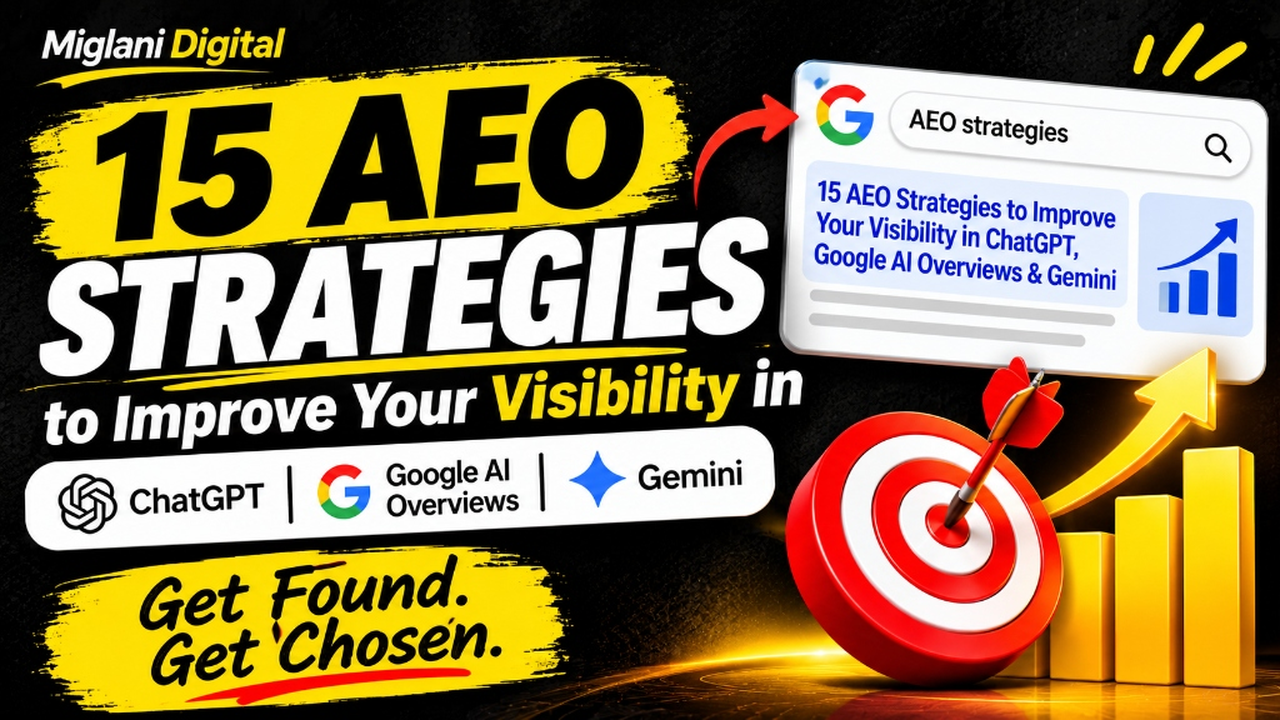
15 AEO Strategies to Improve Your Visibility in ChatGPT, Google AI Overviews & Gemini
Search is evolving from a list of blue links into conversational answer synthesis. When prospective clients ask ChatGPT for vendor recommendations, scan Google AI Overviews, or consult Gemini, is your brand cited as the definitive answer? Here are the 15 essential AEO strategies to transform your content, technical architecture, and entity signals to dominate AI search visibility.
What Are AEO Strategies and How Do They Drive Brand Visibility?
The best AEO strategies are deliberate optimization practices designed to help AI answer engines—including ChatGPT, Google AI Overviews, Gemini, and Perplexity—understand, verify, and cite your website as the definitive answer to buyer queries.
Unlike traditional SEO that targets blue-link rankings, AEO engineers your digital footprint for conversational synthesis. By implementing direct answer-first formatting, unblocking AI crawlers like OAI-SearchBot, establishing interconnected Schema.org graphs, and building multi-platform third-party consensus, your business earns high-intent AI citations and direct client conversions.
- Conversational Intent Mapping: Reverse-engineering the full natural-language questions buyers ask.
- Answer-First Formatting: Placing direct 40–60 word factual answers in opening sentences.
- Entity Schema Engineering: Deploying Organization, Service, and FAQPage JSON-LD graphs.
- Technical AI Accessibility: Permitting OAI-SearchBot and BingBot with zero JavaScript locks.
- Off-Page Web Consensus: Earning authentic citations across G2, Reddit, Capterra, and Forbes.
- Proprietary Evidence (E-E-A-T): Publishing verifiable data, case study metrics, and named credentials.
💡 Want to diagnose your brand's AI search visibility? Claim a Free 25-Point AEO Audit from Harsh Miglani or email miglanidigital@gmail.com.
The Shift from Traditional Search to Answer Engine Optimization
People are fundamentally changing how they discover products and services online. Instead of typing fragmented keywords into a search box and clicking through a dozen blue links, high-intent buyers now ask conversational questions to ChatGPT, review AI-synthesized summaries in Google AI Overviews, and prompt Gemini to compare service providers.
These conversational engines do not simply list websites—they synthesize complex data, extract factual answers, and point users toward authoritative, verified sources. If your brand is missing from that synthesis, you are invisible to the most qualified segment of your market. To build lasting brand visibility in AI search, you need a proactive framework that bridges conventional search tactics with modern ChatGPT SEO and Gemini search algorithms.
That is why executing proven AEO strategies (Answer Engine Optimization strategies) is no longer optional for growing businesses. AEO does not replace traditional SEO; rather, it elevates your content architecture, technical infrastructure, and brand signals so large language models (LLMs) effortlessly select your business as the definitive answer.
1. Understand the Questions Your Customers Actually Ask
Every high-performing AEO strategy begins with customer empathy. Unlike traditional searchers who type shorthand phrases like "AEO consultant pricing", AI users ask complete, conversational questions with specific context:
- "Which digital marketing agency should a growing B2B SaaS startup hire for AEO?"
- "How much does a comprehensive AI search visibility audit cost?"
- "What is the difference between an SEO agency and an AEO consultant?"
These questions reveal the exact pain points and decision criteria of your audience. Your pages must address the underlying problem with clarity, rather than merely stuffing keywords into generic blog copy.
Mine real customer questions from your sales call transcripts, customer support tickets, Reddit communities (r/marketing, r/smallbusiness), and "People Also Ask" clusters. Group them by commercial intent and dedicate distinct landing page sections to answering each query.
2. Give a Direct Answer Near the Beginning of Each Page
When an AI crawler scans your page via Retrieval-Augmented Generation (RAG), its embedding model looks for concise, factual text blocks that directly resolve the prompt. If your readers (and crawlers) have to wade through 500 words of background history before finding the answer, the AI will bypass your site for a competitor.
Adopt the Answer-First Principle: open every core section with a direct, 40–60 word answer that defines the concept, names the solution, or states the timeline and pricing. Follow immediately with supporting evidence, nuances, and actionable steps.
Question: What is Answer Engine Optimization (AEO)?
Answer: Answer Engine Optimization (AEO) is the practice of optimizing website content,
schema graphs, and brand authority signals so AI engines (ChatGPT, Google AI Overviews,
Gemini, Perplexity) extract, cite, and recommend your business as the definitive answer.
3. Create Original Content Instead of Rewriting Existing Articles
Publishing generic summaries that echo whatever ranks on page one of Google gives AI models no reason to cite your domain. LLMs are trained to detect duplicate consensus; they actively seek out information gain—novel insights, original tests, proprietary data, and unique case studies.
In our recent benchmark study testing 10 brands on ChatGPT, we documented 30 live test runs to evaluate citation patterns. That proprietary data earned citations because no other website possessed our exact test numbers. Always infuse your content with primary research and first-hand operational experience.
4. Build Topic Clusters Around Your Main Services
A single article cannot establish comprehensive topical authority. To win AI recommendations, you must demonstrate deep, multi-dimensional expertise through interconnected topic clusters.
For instance, at Miglani Digital, our primary AEO consulting pillar links cohesively to supporting specialized guides:
- AEO Consultant: How to Get Cited by ChatGPT & Perplexity
- AEO Services for Businesses: The Full Agency Roadmap
- How to Optimize Your Website for AI Search in 2026
- 12 Best AEO Tools for Agencies
Connect these pages using descriptive internal anchor text. This semantic web helps search engine algorithms understand the topical breadth of your domain.
5. Make Your Website Frictionlessly Easy to Crawl and Index
No amount of brilliant copywriting can overcome a technical barrier that blocks AI search scrapers. Many AI search tools utilize lightweight HTTP scrapers that do not execute client-side JavaScript or wait for dynamic React hydration.
Review and enforce these non-negotiable technical requirements:
- Unblock AI Crawlers in robots.txt: Explicitly permit
OAI-SearchBot,ChatGPT-User,Google-Extended, andPerplexityBot. - Server-Side Rendering (SSR): Ensure critical answers and pricing tables exist in raw HTML response payloads.
- XML Sitemap Indexing: Submit your clean sitemap to both Google Search Console and Bing Webmaster Tools (which heavily powers ChatGPT search).
- Clean Canonicalization: Prevent duplicate URL parameters and redirect chains that drain crawl budgets.
6. Write Clear Headings That Match Search Intent
Headings are not just aesthetic dividers; they represent the semantic outline that AI models parse to understand context. Avoid vague, cute headings like "Our Magic Formula". Instead, use natural-language headings that match conversational query intent:
H1: 15 AEO Strategies to Improve Your Visibility in ChatGPT, Google AI Overviews & GeminiH2: How ChatGPT Decides Which Businesses to RecommendH3: Step 1: Allow ChatGPT's Search Crawler in Your robots.txt
This structural hierarchy helps AI parsers quickly map a user's prompt directly to the corresponding answer block on your page.
7. Add Deep JSON-LD Structured Data (Schema Graphs)
Structured data acts as a direct translation layer between your human-readable content and the knowledge graphs used by AI answer engines. Deploy connected Schema.org JSON-LD graphs rather than isolated snippets:
| Schema Type | Strategic Purpose in AEO | Key Properties to Include |
|---|---|---|
| Organization / ProfessionalService | Defines your brand entity, core offerings, and founder identity | name, url, sameAs, hasOfferCatalog, founder |
| BlogPosting / Article | Signals topical authorship, verified credentials, and date currency | headline, author, datePublished, dateModified, publisher |
| FAQPage | Explicitly maps natural-language questions to authoritative answers | mainEntity, Question, acceptedAnswer |
| HowTo | Provides structured sequential instructions for procedural AI prompts | name, step, HowToStep, itemListElement |
Always validate your JSON-LD using Google's Rich Results Test and Schema.org Validator before deploying to production.
8. Build Clear and Consistent Brand Information (Entity Resolution)
AI models compute statistical confidence. If your business name, address, phone number, and service definitions vary across the web, the AI's entity resolution algorithms experience friction, resulting in lower recommendation frequency.
Ensure complete consistency across your website, Google Business Profile, LinkedIn Company Page, Crunchbase, and industry associations. Clearly articulate who you serve, what you do, and who leads the company. A verified About page with named leadership builds foundational entity authority.
9. Earn Relevant Mentions and Links from Trusted Third Parties
AI engines do not take your homepage's claims at face value. A landmark Peec AI study analyzing 30 million AI citations revealed that over 85% of citations come from third-party consensus sources rather than self-promotional vendor websites.
Focus your off-page AEO efforts on high-trust third-party platforms:
- Review Portals: Earn verified reviews on G2, Capterra, Trustpilot, or Clutch with specific details on business results.
- Community Forums: Participate authentically in relevant Reddit discussions and Quora questions without spamming links.
- Authoritative Editorial: Secure mentions in reputable industry trade publications, podcasts, and digital news outlets.
10. Use Real Examples, Evidence, and First-Hand Experience (E-E-A-T)
Google's quality evaluators and LLM training algorithms heavily favor E-E-A-T (Experience, Expertise, Authoritativeness, and Trustworthiness). Unsubstantiated claims like "We are the #1 agency" are ignored by conversational models.
Support your claims with verifiable real-world proof:
- Include concrete before-and-after client case studies with verified percentages.
- Document the exact methodology, tools, and testing parameters used in your work.
- Acknowledge legitimate trade-offs—AI engines value nuanced, objective recommendations over relentless sales pitches.
11. Keep Important Content Fresh and Date-Stamped
AI answer engines prioritize up-to-date data for commercial and technical queries. If your guide references tools or algorithms from two years ago, AI models will demote your content in favor of fresher competitors.
Conduct quarterly reviews of your cornerstone service and comparison pages. Update tool recommendations, revise pricing charts, and ensure your dateModified metadata and visible timestamps clearly reflect recent reviews.
12. Improve Page Experience and Mobile Usability
When AI engines provide citation links in answers (such as Google AI Overviews or ChatGPT search footnotes), users who click expect instantaneous loading. If your site is sluggish or cluttered with intrusive interstitial popups, bounce rates spike, signaling low satisfaction to search systems.
Maintain strict Core Web Vitals performance: aim for Largest Contentful Paint (LCP) under 2.0 seconds, zero layout shifts (CLS < 0.05), and responsive mobile typography. Clean, lightweight websites convert AI referral traffic into paying clients at significantly higher rates.
13. Make Images and Visuals Informational, Not Decorative
Modern multimodal models like GPT-4o, Gemini 1.5 Pro, and Google Lens process both text and images simultaneously. Infographics, comparison charts, and technical diagrams that visually answer a question provide valuable multimodal signals.
Ensure every visual asset serves an informational purpose:
- Use descriptive file names (e.g.,
aeo-strategies-ai-search-visibility-thumbnail.pnginstead ofIMG_1024.png). - Write comprehensive, keyword-rich
alttext that explains what the graphic conveys. - Accompany diagrams with accessible text captions so text-based scrapers capture the data.
14. Measure AI Visibility Systematically Instead of Guessing
You cannot optimize what you do not track. Running a single ad-hoc prompt in ChatGPT is not an audit; conversational outputs vary based on session context and algorithmic updates. To systematically evaluate your brand visibility in AI search, you must track real metrics across ChatGPT SEO pipelines and Gemini search summaries.
Establish a structured monthly AEO tracking protocol:
- Compile 20–30 high-intent commercial prompts your potential buyers ask.
- Execute these queries monthly in clean, logged-out sessions across ChatGPT, Google AI Overviews, Gemini, and Perplexity.
- Record whether your brand appears, your position in the answer, the sentiment of the description, and the external sources cited.
- Track referral visits from
chatgpt.com,perplexity.ai, and AI Overview referrals in your Google Search Console.
15. Connect Helpful Content to a Clear, Natural Conversion Path
The ultimate goal of AEO is not vanity citations—it is acquiring qualified, high-intent clients. When an AI engine recommends your brand or a user clicks through your cited source, your landing page must make the next step frictionless.
Offer a low-barrier, high-value transition: such as a Free 25-Point AEO Audit or a 30-minute diagnostic session. Explain exactly what the client will receive, how the audit works, and what actionable deliverables they will get.
Common AEO Mistakes That Sabotage Your AI Search Visibility
Many brands make fundamental errors when trying to optimize for answer engines. Avoid these common missteps:
- Keyword Stuffing: Repeating "AEO strategies" or "AI search optimization" unnaturally does not trick modern LLMs; it degrades readability and triggers spam filters.
- Publishing Low-Quality AI Content: Using generic AI prompts to mass-produce 50 thin blog posts creates zero information gain and damages domain authority.
- Treating Schema as a Silver Bullet: Schema markup clarifies content, but it cannot compensate for inaccurate, unhelpful, or poorly written copy.
- Accidentally Blocking AI Crawlers: Copy-pasting aggressive robots.txt directives that inadvertently block
OAI-SearchBotor BingBot. - Testing Only Once: Drawing premature conclusions from a single test prompt rather than running multi-session benchmark tests.
How Miglani Digital Helps You Win AI Search Clients
At Miglani Digital, we help ambitious businesses, SaaS founders, and marketing agencies bridge the gap between traditional SEO and conversational answer engines. Led by Harsh Miglani, we engineer technical infrastructure and answer-first content that gets your brand chosen by ChatGPT, Google AI Overviews, and Gemini.
B2B SaaS Consultancy: AI Citation Share Grew from 8% to 64% in 75 Days
A boutique enterprise consultancy was completely invisible in ChatGPT and Perplexity recommendations. By deploying our 15 AEO strategies—rebuilding answer-first landing pages, fixing firewall crawler blocks, and deploying interconnected JSON-LD schema graphs—we achieved measurable pipeline growth:
"Harsh Miglani restructured our digital presence so AI engines actually understand who we are and why we matter. We now get qualified enterprise leads mentioning they found us through ChatGPT."
What You Receive in Our Comprehensive AEO Consulting Service:
Multi-Engine AI Audit
We test 25+ real buyer prompts across ChatGPT-4o, Google AI Overviews, Gemini, and Perplexity to identify citation gaps.
Technical Crawler Hardening
We audit robots.txt, Cloudflare WAF, and SSR architecture to ensure seamless indexing by OAI-SearchBot and BingBot.
Answer-First Architecture
We rewrite key commercial landing pages with concise factual answers and comparison tables that LLMs cite effortlessly.
Entity Schema Engineering
We deploy interconnected JSON-LD schema graphs linking your brand, services, leadership, and external reviews.
Ready to Win AI Search Recommendations?
Submit your website details below. Harsh Miglani will run a preliminary 25-point AEO audit on your brand across ChatGPT, Google AI Overviews, and Gemini, returning a custom action plan within 24 hours.
Frequently Asked Questions About AEO Strategies
What are AEO strategies?
AEO strategies are systematic methods used to make a website's information easier for answer engines and AI-powered search tools (such as ChatGPT, Google AI Overviews, and Gemini) to understand, discover, and reference. They include answering customer questions clearly, improving technical crawlability, publishing original proof, and building cross-web entity consensus.
How do I optimize my website for ChatGPT?
To optimize for ChatGPT: ensure OAI-SearchBot and ChatGPT-User are permitted in your robots.txt and firewall, ensure indexation in Bing Webmaster Tools, write answer-first content that answers buyer queries in the opening sentences, and build authoritative third-party reviews on G2, Capterra, and Reddit.
How can my website appear in Google AI Overviews?
To appear in Google AI Overviews, your page must be indexed and eligible in core Google Search. Follow technical SEO best practices, provide direct, factual answers under conversational H2 headings, maintain strong E-E-A-T signals, and structure content cleanly in readable HTML without JavaScript barriers.
Is AEO different from SEO?
Yes. Traditional SEO focuses on earning clicks across ten ranked blue links in search results. AEO (Answer Engine Optimization) focuses on conversational synthesis—ensuring AI models extract, cite, and recommend your brand as the single authoritative answer to conversational buyer prompts.
Does FAQ schema help with AI search visibility?
Yes. FAQPage JSON-LD schema helps AI search crawlers explicitly map natural-language questions to precise factual answers. While schema alone does not guarantee inclusion, it significantly increases the likelihood of accurate AI citation by clarifying semantic relationships.
How often should I update AEO content?
Review your primary commercial content quarterly. AI retrieval-augmented generation (RAG) engines favor current data and active timestamps. Update pricing, feature specs, and product comparisons whenever changes occur to maintain high freshness scores.
Can small businesses benefit from AEO strategies?
Absolutely. Because AI answer engines prioritize specific intent matching over raw domain authority, small businesses that provide direct, authoritative answers to niche questions frequently outperform large enterprise competitors in AI search results.
How do I measure AEO performance?
Track AEO performance by measuring: 1) AI citation share across repeatable monthly prompt tests on ChatGPT, Gemini, and Perplexity, 2) referral traffic from AI platforms in web analytics, 3) organic search impressions and clicks in Google Search Console, and 4) qualified inbound leads that cite AI discovery.