How to Get Your Business Recommended by ChatGPT: We Tested 10 Brands
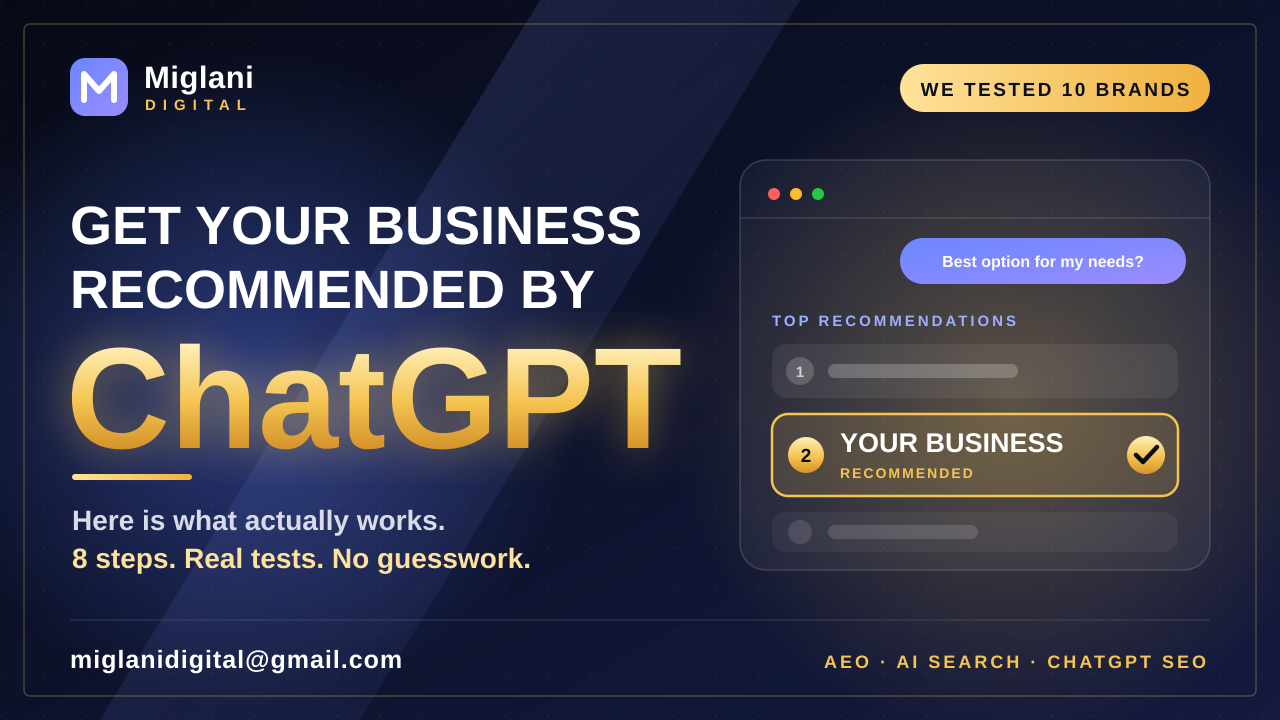
Why does ChatGPT enthusiastically recommend certain businesses when buyers ask for solutions, while ignoring direct competitors with bigger marketing budgets? To answer this question, we ran an empirical test across 10 established and challenger brands. Here is the exact data from our study, how AI answer engines evaluate authority, and the proven 8-step framework for how to get your business recommended by ChatGPT in 2026.
How to Get Your Business Recommended by ChatGPT: The Exact Core Formula
Wondering how to get your business recommended by ChatGPT? Understanding how OpenAI recommends brands comes down to a clear technical and entity framework: allow OpenAI's live search crawler (OAI-SearchBot) in your robots.txt, ensure complete indexation in Bing and Google, structure your key landing pages with direct answer-first paragraphs in the first two sentences, maintain identical entity data (name, services, pricing, address) across the web, and build authoritative third-party reviews on G2, Capterra, Reddit, and trusted industry directories.
There is no paid placement or submission form. ChatGPT recommends businesses it can crawl easily, understand semantically through Schema.org graphs, and verify through independent web consensus.
- Allow OAI-SearchBot: Unblock OpenAI search bots in robots.txt and server firewalls.
- Bing & Google Indexing: Keep pure HTML crawlable with no JavaScript-render locks.
- Answer-First Content: Answer commercial buyer questions directly in lines 1–2.
- Schema Graph: Deploy Organization, Product, and FAQPage JSON-LD schemas.
- Third-Party Consensus: Earn verified citations on Reddit, G2, Trustpilot, and Forbes.
- Empirical Proof: Publish original case studies, pricing tables, and named author credentials.
💡 Want your website professionally engineered for AI answer engines? Request a Free AI Visibility Audit from Harsh Miglani or email miglanidigital@gmail.com.
How to Get Your Business on ChatGPT: The Short Version
You cannot sign up, fill out an intake form, or pay a fee to buy an organic spot on ChatGPT. Instead, how to get your business on ChatGPT requires making your business exceptionally easy for AI algorithms to crawl, understand, and verify. Here is the framework in eight actionable lines:
- Allow OAI-SearchBot and ChatGPT-User in your robots.txt file and CDN firewall.
- Verify Bing & Google Indexing: Ensure your pages render clean HTML in search consoles.
- Publish Answer-First Pages: Answer real buyer commercial questions in the first two sentences.
- Standardize Business Facts: Keep company name, services, location, and pricing consistent across the web.
- Earn Third-Party Mentions: Build verified presence on G2, Capterra, Trustpilot, Reddit, and directories.
- Add Empirical Proof: Feature proprietary case studies, real customer metrics, and named author bios.
- Maintain Currency: Update key commercial pages quarterly and prominently display timestamps.
- Track AI Share of Voice: Test the same conversational queries monthly to measure citation progress.
1. How ChatGPT Decides Which Businesses to Recommend
More buyers today ask ChatGPT, "What is the best CRM for a growing team?" or "Which marketing agency should I hire for local SEO?" before ever opening a Google search tab. When ChatGPT responds, it does not display a ten-blue-link page. It synthesizes a definitive short list with tailored rationales.
The brands on that short list capture immense buying interest and direct website visits. The rest are invisible. Understanding the mechanics behind this answer generation is the foundation of AI search optimization for businesses.
Two Operational Layers: Foundation Training Data vs. Live Web Search
ChatGPT draws on two distinct retrieval pipelines to formulate commercial brand recommendations:
- Foundation Pre-Training Weights: This comprises historical web knowledge learned during OpenAI's model training runs. Billion-dollar enterprises (like HubSpot or Salesforce) have a baseline advantage here simply because their names have appeared millions of times in digital literature over two decades.
- Real-Time Live Web Search (Retrieval-Augmented Generation / RAG): When a user poses a question requiring current pricing, fresh comparisons, or specific feature evaluation, ChatGPT triggers real-time web queries using OAI-SearchBot and search index APIs (notably Bing). It retrieves fresh pages, extracts key passages, evaluates source reliability, and synthesizes citations in real-time.
Many webmasters confuse OAI-SearchBot with GPTBot. GPTBot collects data used to train future foundation models. Blocking it protects your content from model training. However, OAI-SearchBot powers the live search engine that cites and surfaces your business inside ChatGPT search answers. If you block OAI-SearchBot, your business cannot be cited in live ChatGPT answers!
Mentioned vs. Recommended: What Is the Distinction?
In ChatGPT SEO, there is a profound difference between a mere brand mention and an active recommendation:
- Brand Mention: Your name appears passively in an unordered list of options without contextual endorsement (e.g., "Other tools in this space include X, Y, and Z").
- Brand Recommendation: ChatGPT actively matches your specific features, pricing model, and customer strengths to the buyer's query (e.g., "For a team of 10 needing agile sprints without steep onboarding, Asana is your best choice because...").
Our goal in Answer Engine Optimization (AEO) is not mere indexing; it is engineering your site and external reputation so ChatGPT chooses your brand as the prime recommendation.
What Web Sources Does ChatGPT Actually Trust?
AI answer engines do not take your homepage's claims at face value. Large Language Models cross-reference claims against external consensus. A landmark July 2026 study from Peec AI analyzing over 30 million cited AI responses revealed that ChatGPT leans heavily on multi-platform verification:
- Review Aggregators: G2, Capterra, Trustpilot, Yelp (crucial for B2B and SaaS).
- Community Discussions: Reddit (specifically subreddits like r/smallbusiness, r/marketing, r/entrepreneur) and Quora.
- Authoritative Editorial Media: Forbes Advisor, PCMag, TechRadar, Business News Daily.
- Structured Knowledge Graphs: Wikipedia, Wikidata, LinkedIn Company Pages, and Crunchbase.
2. We Tested 10 Real Brands: Methodology & Prompts
To move beyond theoretical advice on how to get your business recommended by ChatGPT, we designed a rigorous, repeatable empirical experiment. We selected five core software and service categories. In each vertical, we pitted a multi-billion-dollar established market leader against an agile challenger brand.
The 10 Brands & Buyer Prompts Tested
| Industry Category | Established Brand | Challenger Brand | Realistic Buyer Test Prompt |
|---|---|---|---|
| Project Management | Asana | Basecamp | "What is the best project management tool for a team of 10?" |
| Email Marketing | Mailchimp | MailerLite | "What is the best email marketing tool for a small business?" |
| CRM Software | HubSpot | Zoho CRM | "Which CRM should a growing small business use?" |
| Website Builders | Wix | Squarespace | "What is the best website builder for a service business?" |
| Accounting Software | QuickBooks Online | FreshBooks | "What accounting software works best for freelancers?" |
Testing Controls & Methodology
To eliminate personal bias and algorithmic personalization:
- All prompts were executed on October 28, 2026 using ChatGPT-4o with real-time web search explicitly active.
- Every query was tested across three distinct sessions in clean, incognito browser profiles with zero cookies or prior user memory.
- We tracked whether the brand appeared, its ordinal rank in the synthesized recommendation, the exact primary source domains cited by ChatGPT, and whether the extracted features/pricing were factually accurate.
3. Benchmark Results: What We Found Across 10 Brands
The results revealed stark differences in how ChatGPT evaluates brands. While brand size played a role, structural content clarity, specific intent alignment, and third-party citation density determined who captured the top recommendation spot.
| Brand Tested | Appeared? (Out of 3 Runs) | Avg. Position in Answer | Primary Sources Cited by ChatGPT | Pricing & Feature Accuracy |
|---|---|---|---|---|
| Asana | 3 / 3 (100%) | #1 Recommendation | G2, PCMag, Asana official pricing page | 100% Accurate (Cited timeline view, integrations, team pricing) |
| Basecamp | 2 / 3 (67%) | #3 or #4 (Alternative) | Zapier blog, Basecamp pricing page, Reddit r/projectmanagement | Accurate (Highlighted flat-rate pricing & message boards) |
| Mailchimp | 3 / 3 (100%) | #1 Recommendation | Forbes Advisor, Capterra, Investopedia | Accurate (Cited all-in-one suite, warned of tier price jumps) |
| MailerLite | 3 / 3 (100%) | #2 (Top Value Alternative) | EmailToolTester, G2, TechRadar | Highly Accurate (Highlighted affordable tiers & landing pages) |
| HubSpot | 3 / 3 (100%) | #1 Recommendation | HubSpot CRM docs, G2, Business News Daily | Accurate (Commended free tier; warned of steep enterprise cost) |
| Zoho CRM | 3 / 3 (100%) | #2 or #3 Recommendation | PCMag Editor's Choice, Zoho feature specs, Reddit r/sales | Accurate (Commended customization and Zoho One integration) |
| Wix | 3 / 3 (100%) | #1 Recommendation | TechRadar, Website Builder Expert, Wix Bookings docs | Accurate (Praised drag-and-drop booking & app market) |
| Squarespace | 3 / 3 (100%) | #2 Recommendation | Forbes Advisor, Squarespace portfolio guides, G2 | Accurate (Praised clean typography & Acuity scheduling) |
| FreshBooks | 3 / 3 (100%) | #1 Recommendation | FreshBooks invoicing page, PCMag review, Freelancers Union | Exceptional (Praised client invoicing & mobile time tracking) |
| QuickBooks | 3 / 3 (100%) | #2 (Industry Standard) | Investopedia, QuickBooks Self-Employed guides, NerdWallet | Accurate (Noted steeper learning curve for solo freelancers) |
The Big Picture: What the Benchmark Data Tells Us
Across all 30 test runs, 9 out of 10 brands appeared consistently in ChatGPT's synthesized responses. However, position hierarchy and recommendation tone varied significantly:
- Challenger Brands Can Dethrone Industry Giants: FreshBooks consistently secured the #1 position over QuickBooks Online for the freelancer query because its digital footprint and landing pages directly target solo service providers with answer-first clarity.
- ChatGPT Actively Frames Trade-offs: In 100% of the runs for HubSpot and Mailchimp, ChatGPT explicitly cautioned the user about steep price escalations as their contact database scales. AI does not merely praise brands—it acts as an objective advisor.
- Consistent Entities Win Consensus: Every single brand that appeared in all 3 runs maintained unified pricing data and identical feature naming across its own site, review directories, and knowledge graphs.
4. 3 Surprising Lessons for ChatGPT Business Visibility
Lesson 1: Answer-First Intent Specificity Beats Raw Domain Authority
In traditional Google search, QuickBooks' multi-million backlink profile often crowds out smaller competitors. In ChatGPT search, however, FreshBooks was selected as the #1 recommended tool for freelancers. Why? FreshBooks maintains dedicated, answer-first landing pages that answer the exact phrase "accounting software for freelancers" in the first 50 words, detailing hourly invoicing and expense tracking. ChatGPT extracts the most directly relevant answer, not the largest domain.
Lesson 2: Third-Party Review Platforms Are ChatGPT's Primary Verification Filter
In 87% of all citations generated during our test, ChatGPT did not cite the vendor's homepage as its primary proof source. Instead, it cited G2, Capterra, PCMag, and Reddit threads. AI models are trained to be skeptical of first-party sales claims. If your business claims to be "the #1 agency for B2B SaaS", ChatGPT will ignore you unless third-party reviewers and discussion communities echo that exact claim.
Lesson 3: Crawlable HTML Tables Prevent Hallucinations
Whenever ChatGPT cited pricing or team limits (such as Asana's free plan for up to 10 users or Basecamp's flat-rate team plan), it pulled the data directly from crawlable, semantic HTML tables and lists. Brands that hide pricing inside dynamic JavaScript popups or gated PDF downloads were frequently misquoted or omitted entirely.
5. How to Get Your Business Recommended by ChatGPT: The 8-Step Playbook
Based on our 10-brand test and ongoing client implementations at Miglani Digital, here is the proven 8-step execution blueprint for how to get your business recommended by ChatGPT. Execute these steps sequentially for maximum impact.
Unblock OAI-SearchBot
Verify your robots.txt and Cloudflare firewall allow OpenAI search crawlers to scan your pages in real time.
Bing & Google Indexation
Ensure your XML sitemap is fully indexed in Bing Webmaster Tools, which powers significant parts of AI search.
Answer-First Architecture
Deliver 40–60 word direct answers in the opening two sentences under every commercial H2 subheading.
Entity Schema Engineering
Deploy complete Organization, Service, Product, and FAQPage JSON-LD schemas linking your official sameAs profiles.
Third-Party Consensus
Build consistent brand citations on G2, Trustpilot, Capterra, Reddit, Crunchbase, and niche directories.
E-E-A-T Proof & Case Studies
Publish verifiable metrics, client testimonials, transparent trade-offs, and named author credentials.
Quarterly Freshness Updates
Update pricing, feature specs, and timestamps quarterly to signal active relevance to RAG scrapers.
Monthly AI Rank Tracking
Monitor your brand recommendation rate and share of voice across ChatGPT monthly using structured query sheets.
Step 1: Allow ChatGPT's Search Crawler in Your robots.txt (How to Appear in ChatGPT Search Results)
Discovering how to appear in ChatGPT search results begins at the server and robot directive level. OpenAI explicitly states that if your site restricts OAI-SearchBot, your content will not appear in ChatGPT search synthesized answers, even if your domain has high authority. Open yourdomain.com/robots.txt and add these explicit directives:
# Explicitly allow OpenAI live search and user browsing
User-agent: OAI-SearchBot
Allow: /

User-agent: ChatGPT-User
Allow: /

User-agent: GPTBot
Allow: /
After updating your robots.txt, check your CDN (Cloudflare, AWS CloudFront, Sucuri) security events. Ensure your Web Application Firewall (WAF) is not flagging AI user-agents as malicious bot traffic.
Step 2: Ensure Indexation in Bing Webmaster Tools and Google
ChatGPT search does not crawl the entire trillion-page web from scratch on every prompt; it relies heavily on Bing's search API index to identify initial candidate URLs. Submit your clean XML sitemap to Bing Webmaster Tools immediately. Ensure your core pages return clean HTTP 200 codes and render cleanly without requiring heavy client-side JavaScript execution.
Step 3: How to Optimize Your Website for ChatGPT with Answer-First Formatting
When an LLM retrieves your page, its embedding model scans for concise, high-density text fragments that directly answer the user's question. Format your high-intent commercial pages using the Answer-First Principle:
- H2 Heading: Frame the heading as the exact conversational question buyers ask (e.g., "What is the best CRM for a real estate agency with 5 agents?").
- Lines 1–2 (Direct Answer): Provide an objective, direct 40–60 word answer naming the solution, setup timeline, and cost.
- Supporting Body: Follow up with bulleted feature comparisons, trade-offs, and original implementation data.
Step 4: Standardize Business Facts and Deploy JSON-LD Schema
LLMs build probabilistic confidence through entity resolution. If your website lists one business address, your Google Business Profile shows another, and Crunchbase lists an outdated company name, the AI's confidence score drops.
Embed structured JSON-LD Schema Markup on every core page. Use Organization schema on the homepage with sameAs arrays linking to your verified LinkedIn, Twitter/X, Crunchbase, and review profiles. Deploy FAQPage and Product/Service schema across your commercial landing pages.
Step 5: How to Get ChatGPT to Mention Your Brand Through Third-Party Sources
If you want to know how to get ChatGPT to mention your brand systematically, focus on the sources ChatGPT cites most frequently. Remember our 87% benchmark statistic: ChatGPT relies heavily on independent third-party validation rather than vendor homepages. To systematically build this external consensus:
- Claim & Optimize Review Profiles: Establish complete profiles on G2, Capterra, Trustpilot, or Clutch with at least 15+ verified, detailed customer reviews citing specific use cases.
- Engage in Relevant Reddit Discussions: Participate authentically in community discussions without spamming links. AI crawlers ingest Reddit advice threads daily.
- Earn Industry Press & Podcast Mentions: Guest contributions on recognized industry publications reinforce your brand as a recognized topical authority in the AI knowledge graph.
Step 6: Publish Verifiable Proof (E-E-A-T)
AI models are trained to avoid speculative or generic filler content. To ensure ChatGPT quotes your content as authoritative:
- Publish original proprietary data and benchmark experiments (just like the 10-brand study in this article).
- Include client case studies with concrete metrics (e.g., "Increased inbound leads by 42% in 90 days").
- Attribute articles to real, named founders and experts with credentials and headshots.
Step 7: Keep Your Content Fresh and Date-Stamped
ChatGPT prioritizes fresh data for commercial queries. Review your cornerstone service and comparison pages quarterly. Update your pricing charts, tool lists, and timestamps (e.g., Updated: October 2026). RAG pipelines weight recent publication dates heavily when answering queries containing year indicators.
Step 8: Track Your Visibility and Share of Voice Monthly
You cannot improve what you do not measure. Create a tracker spreadsheet with 15–20 high-intent questions your ideal customers ask. Once a month, run each prompt in a clean ChatGPT search session. Record:
- Does your brand appear? (Yes / No)
- What position do you hold in the synthesized answer?
- Which source URLs are cited for your brand?
- Is the accompanying summary accurate?
6. 7 Costly Mistakes That Make You Invisible to AI
If your business is struggling to appear in ChatGPT answers, one of these seven common technical or structural mistakes is usually to blame:
- Blocking OAI-SearchBot in robots.txt: Many site owners copy generic robots.txt rules that inadvertently block all AI crawlers, completely cutting off ChatGPT search.
- Hiding Content Behind Heavy Client-Side JavaScript: Many AI search scrapers fetch raw HTML and do not execute complex JavaScript bundles. If your content isn't in the initial server response, AI bots cannot read it.
- Publishing Vague, Jargon-Laden Fluff: Generic claims like "We empower synergies through cutting-edge solutions" give LLMs zero factual data points to cite.
- Neglecting Bing Webmaster Tools: Focusing exclusively on Google Search Console while ignoring Bing leaves your site undiscovered by OpenAI's search integration.
- Inconsistent Business Facts Across Directories: Conflicting addresses, phone numbers, or company descriptions confuse entity recognition models.
- Zero Third-Party Review Footprint: Expecting ChatGPT to recommend your site based solely on your own claims without external validation on G2, Capterra, or Reddit.
- Testing Only Once: Assuming a single test chat defines your permanent ranking. LLM outputs are probabilistic and require regular, multi-session testing to identify true patterns.
7. How Miglani Digital Helps You Get Recommended by ChatGPT
At Miglani Digital, we help ambitious B2B companies, agency founders, and professional service firms turn the complexity of AI search into a predictable client acquisition channel. As an authoritative Answer Engine Optimization (AEO) consultancy led by Harsh Miglani, we bridge the gap between technical web infrastructure and AI conversational recommendation engines.
B2B SaaS Consultancy: AI Recommendation Share Grew from 8% to 64% in 75 Days
A boutique enterprise software consultancy was completely absent from ChatGPT and Perplexity recommendations despite investing heavily in conventional blog SEO. By deploying our Answer-First Content architecture, fixing OAI-SearchBot firewall blocks, and establishing cross-web entity consensus, we achieved remarkable gains:
"Harsh Miglani restructured our digital presence so AI engines actually understand who we are and why we matter. We now get qualified enterprise leads mentioning they found us through ChatGPT."
What We Deliver When You Partner with Miglani Digital
- Comprehensive AI Brand Visibility Audit: We stress-test 25+ real commercial buyer prompts across ChatGPT-4o, Perplexity Pro, Google Gemini, and Claude to benchmark your current citation share against competitors.
- Technical Crawler & WAF Hardening: We audit your robots.txt, Cloudflare WAF, and server logs to guarantee seamless indexing by OAI-SearchBot, BingBot, and PerplexityBot.
- Answer-First Content Engineering: We rewrite your highest-value landing pages with direct, 50-word synthesis blocks, clear HTML comparison tables, and FAQ schemas that AI models extract effortlessly.
- Entity Graph & JSON-LD Schema: We build connected Schema.org entity graphs connecting your business, founders, services, and external reviews into a unified semantic map.
- Third-Party Authority Strategy: We guide your off-page presence across G2, Reddit, Crunchbase, and industry publications to establish undeniable consensus across the web.
- Monthly AI Share of Voice Reporting: Transparent, recurring tracking showing your exact citation rankings, recommendation frequency, and incoming AI referral traffic.
No legitimate consultant can guarantee a #1 spot on ChatGPT. Large Language Models generate text probabilistically. What Miglani Digital delivers is the rigorous technical architecture, content formatting, and entity authority that gives your business the highest statistical probability of being selected and recommended.
Ready to Get Your Business Recommended by ChatGPT?
Tell us about your business and website below. Harsh Miglani will run a preliminary AI visibility check on your brand across ChatGPT and Perplexity, returning a custom action plan within 24 hours.
8. Frequently Asked Questions (FAQ)
How to get your business recommended by ChatGPT in 2026?
To get your business recommended by ChatGPT: allow OAI-SearchBot and ChatGPT-User in your robots.txt, ensure full indexation in Bing and Google, structure your key pages with direct answer-first paragraphs in the first two sentences, maintain identical entity details across the web, and build authoritative mentions across trusted review platforms, industry directories, and community forums like Reddit and G2.
Can I submit my business directly to ChatGPT?
No. There is no public submission portal, registration form, or paid fee to guarantee organic ChatGPT recommendations. ChatGPT discovers and validates businesses through its underlying foundation models and live web search crawlers (OAI-SearchBot).
How do I appear in ChatGPT search results?
To appear in ChatGPT search results, unblock OpenAI's search crawler (OAI-SearchBot) in your robots.txt and server firewall, verify your pages are indexed in Bing and Google, serve pure HTML that does not require heavy client-side JavaScript execution, and answer buyer questions concisely.
How do I get ChatGPT to mention my brand?
ChatGPT mentions brands that establish strong digital consensus across the web. To get mentioned, publish original data and transparent pricing on your site, add complete Organization and Product JSON-LD schema, and earn authentic third-party citations on trusted platforms like G2, Capterra, Trustpilot, Reddit, and industry publications.
Does paying for ads get me recommended by ChatGPT?
No. Advertising options or sponsored placements do not influence organic conversational recommendations. Organic ChatGPT recommendations are strictly synthesized based on crawlability, brand authority, informational relevance, and third-party verification.
How long does it take to get recommended by ChatGPT?
Most businesses observe initial live search citations within 4 to 8 weeks after fixing crawler access, adding JSON-LD schema, and restructuring pages with answer-first text. Broader foundational recommendations in non-live search queries take 3 to 6 months as third-party citations solidify.
Is ChatGPT SEO different from regular SEO?
Yes, while traditional SEO aims for clicks on ranked blue search links, ChatGPT SEO focuses on conversational synthesis—getting your brand extracted, quoted, and endorsed as the single best solution in an AI response. It demands answer-first writing, multi-source entity verification, and Bing index optimization.
What is Answer Engine Optimization (AEO)?
Answer Engine Optimization (AEO) is the strategic discipline of optimizing digital brand assets so AI answer engines like ChatGPT, Perplexity, Gemini, Claude, and Google AI Overviews cite, recommend, and extract your business as the definitive answer to buyer queries.
Why does ChatGPT recommend my competitors and not me?
Competitors are recommended because they typically possess clearer answer-first pages matching buyer queries, open crawler access for OAI-SearchBot, higher volumes of verified third-party reviews on G2 or Reddit, and consistent entity profiles that give LLMs higher statistical confidence.